During milking, a light flashes. Straight away, the milk staff knows: the conductivity of that teat is off. A sensor that measures conductivity, milk volume, milk flow, the temperature and the vacuum level. In addition to monitoring udder health at the teat level, the sensor also provides a detailed overview of milking performance. That’s the Milk Sensor, CowManager’s latest innovation.
The story behind CowManager’s newest innovation
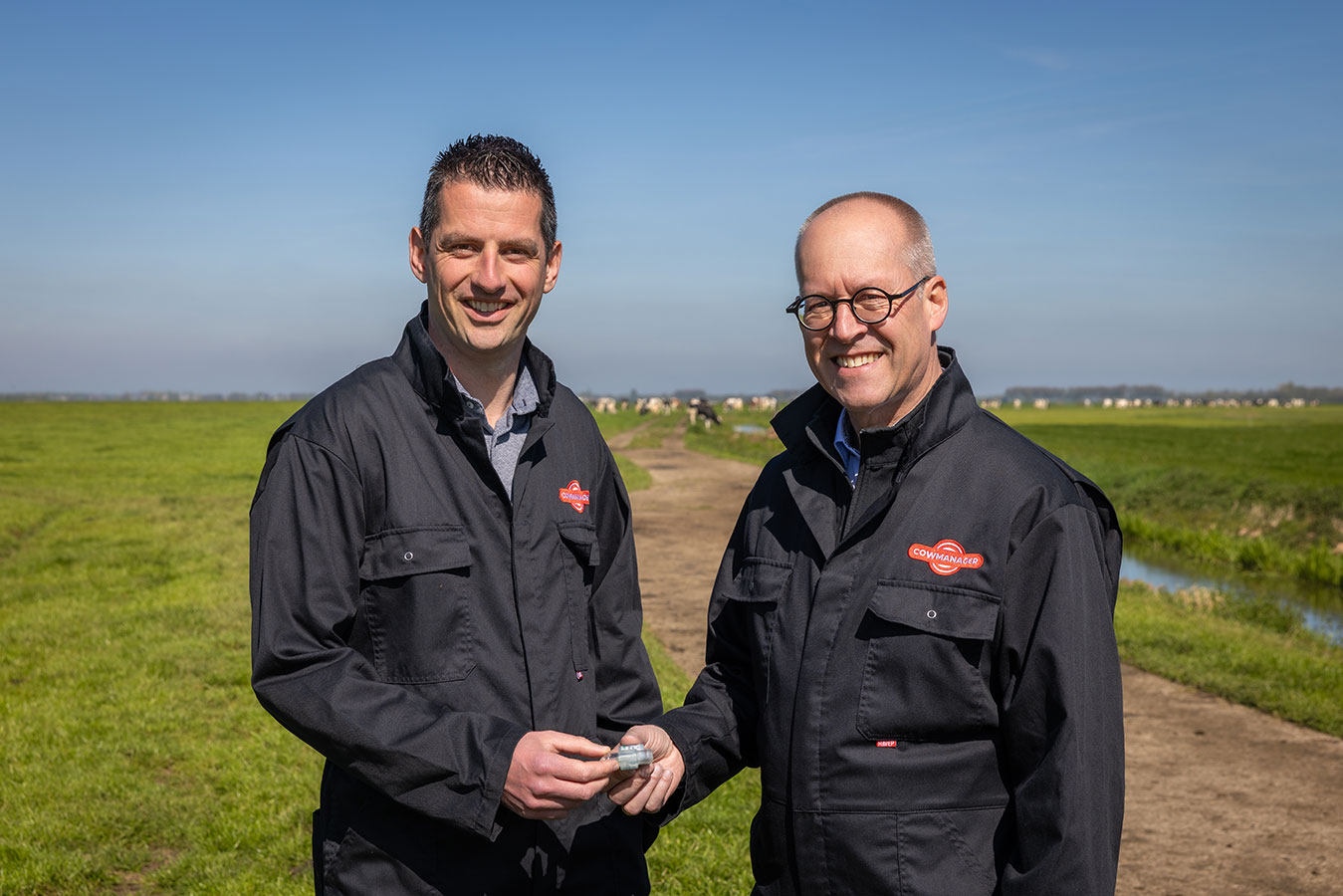
CowManager’s Koen van Meurs and Gerard Griffioen with the Milk Sensor.
“Thanks to the Milk Sensor, farmers can stay one step ahead of udder health issues,” says Gerard Griffioen, dairy farmer and founder of CowManager. Mastitis not only affects milk production and animal health, it also affects profit. That is why preventing it is vital.
“When I was visiting one of our customers who milks about 125,000 cows, I saw his struggle with mastitis and the accuracy of his milk data. Cows were left unidentified and for them, no milk production data was available. And at the same time there was a wealth of data from other cows – but unreliable,” Griffioen recalls.
That’s how the idea for the Milk Sensor came about.
“Our Milk Sensor was developed in collaboration with dairy farmers,” says Koen van Meurs, Head of Product Development, enthusiastically.
Because the Milk Sensor measures at the teat level and CowManager has an extensive global network of large-scale dairy farms, a significant amount of data has been collected in a short amount of time.
Comparing our results with milk analyses from the lab was a big part of the development process and vital for ensuring maximum reliability. Artificial Intelligence, in combination with CowManager’s many years of experience with algorithms and large-scale data, resulted in a smart, advanced and reliable dashboard.
Five indicators in one Milk Sensor
The Milk Sensor currently has five indicators: temperature, conductivity, milk volume, milk flow and the vacuum level.
“The Milk Sensor is positioned very close to the udder to ensure reliable data. Milk quality has also been taken into account: the sensor ensures a clean, unobstructed milk flow. The system can be fully customised. Installation is quick and easy: cut the tube beneath the milk cup, slide the transparent sensor into place and reattach the tubes on either side of the sensor. This works with virtually any brand and type of milk cup in the cow shed,” Gerard explains.
CowManager’s Milk Sensor is available to all dairy farmers who have a CowManager ear sensor or who wish to purchase one. In the future, the Milk Sensor can also be upgraded with cow identification.
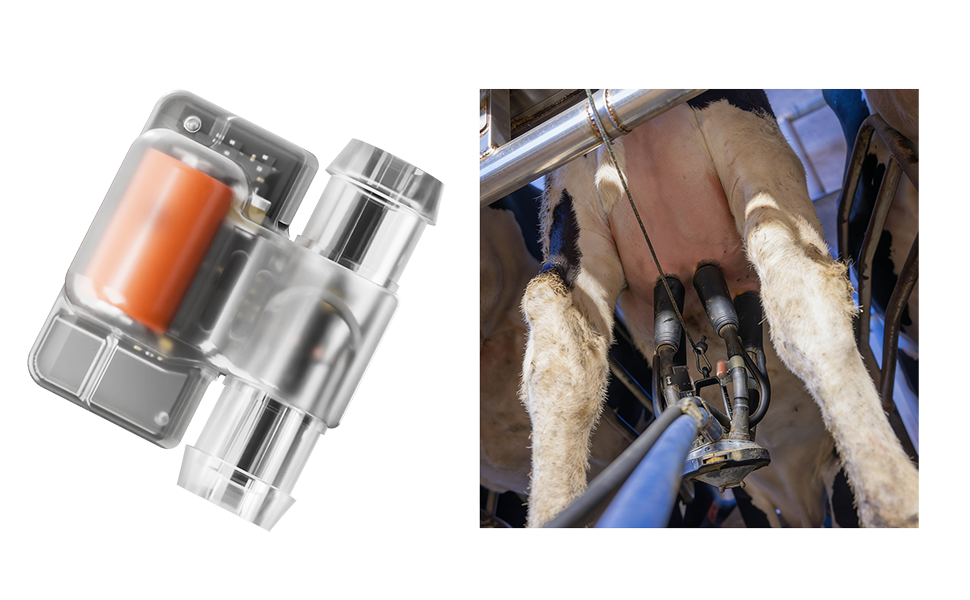
Left: CowManager Milk Sensor. Right: The Milk Sensor in action during milking.
Early detection and prediction of mastitis
Helping to detect and even predict mastitis is one of the Milk Sensor’s main features. Continuous monitoring of the milking process has a positive effect on teat health and can prevent risk factors for mastitis such as teat tip calluses.
The Milk Sensor can also play a key role in producing milk with a low somatic cell count. Gerard and Koen are looking even further ahead.
“This preventive approach has a positive impact on animal welfare. It will help reduce culling due to high cell counts or mastitis problems,” the men predict. “This ultimately results in a longer lifespan for the cows,” Gerard explains.
Performance of each unit at a glance
Another main feature of the Milk Sensor is to analyse the milking process down to the level of individual milk cups.
“The proper functioning of a cow shed is essential for preventing udder problems. Blind milking, air in the milk or a low flushing temperature aren’t visible, but they can pose a huge risk when it comes to mastitis or a high bacterial count,” Koen explains.
The Milk Sensor monitors this and helps detect mastitis. The Milk Sensor also ensures continuity throughout the milking process when multiple milkers are involved. Any differences between milking staff or milking sessions will immediately become visible.
“The combination of the ear and Milk Sensor and the accompanying sorting gate offers unprecedented possibilities,” says Gerard about the entire CowManager ecosystem. The Milk Sensor is a key component of the overall package.
But, according to Koen and Gerard, that’s not all. “This is just the first step. Eventually, the Milk Sensor will be able to measure even more parameters in both the milk and the cow shed,” Koen reveals.
Discover More
The Milk Sensor adds a new layer of insights – quarter-level milk data that connects to the health and performance signals you’re already tracking with CowManager ear sensors.
Sign up now to be first in line for Milk Sensor updates, trial insights and availability announcements.
Stay Up to DateVet Plus veterinarian Kyle Kannan has been working with Paul and Sarah Koopal for years. The Koopals are third generation farmers in Rerewhakaaitu, Central Plateau, and won the CowManager system in NZDIA’s Shared Farmer of the Year category in 2024.
Ever since then, Paul and Kyle have been exploring and utilising all the data from the CowManager system together, to take the already high performing farm to the next level.
Cow Tags Tracking Animal Health
With CowManager ear sensors, they track the herd’s ear temperature, rumination and eating time, activity and behaviour. According to Paul, it’s been a life changer for animal health.
He says: “It’s a real simple app on my phone, on my desktop in the cow shed, or at home. I have alerts come through, like health alerts for sick cows or suspicious cows. You’re picking up something that’s wrong with the cow a lot earlier than you would without the tech. We can intervene a lot earlier.”
It allows the Koopals to reduce the use of antibiotics, which they consider a huge plus.
Paul: “Because we’re picking up sick animals before they’re actually sick, before they know they’re sick, you can make calls on what you’re treating them with. Sometimes it’s just a case of giving them an anti-inflammatory and then they’re back to normal within a day. Whereas if you didn’t have that tech and you didn’t know she was sick until she was sick, you might need to use more antibiotics.”
Better Results Thanks to Tech
Animal health isn’t the only benefit of using the CowManager system. According to Vet Plus vet Kyle Kannan, it’s just scratching the surface.
He says: “There’s also a ton of animal health related to nutrition. Like, how well we feed cows. That has a massive impact on the health of a herd, the health of an individual animal. That information is all coming through as well. And then on top of that, there’s fertility. Which is a key driver of profitability and an integral part of the farm business.”
Paul agrees and shares how the high-tech cow tags have helped him during mating.
“In the cow shed it saves us a lot of time and a lot of labour. Our milkings during mating have become a lot quicker because we’re not having to check tail paint, we’re not having to jump up and check every single cow that comes through.
Because we’re doing AI all the way through our mating, we can use a lot more of the short gestation semen on our herd. The cows that have been given that semen are calving 12 to 13 days earlier, so that’s more days in milk for us on farm. We’re able to actually have more cows in calf as well.”
“And”, he adds, “Because we’ve got CowManager picking up cows that are on heat, we don’t use bulls anymore on farm. That’s been quite a health and safety benefit.”
Unveiling New Data for Vets
Kyle emphasises that cow tag technology isn’t just valuable for farmers – it’s a high-tech treasure chest for vets, too.
“We’re getting information that we’ve never been able to directly measure. You can’t see if your cows are full, or how much they’ve eaten. They look reasonably content, but now we’re getting live data pieces that say, ‘that cow is definitely content’, at a herd level. Now we can jump into our phone and onto our computer screen and actually put some solid information around that.”
Kyle continues: “As vets, we see the more retrospective data that comes through. There was a large scale of information that we just didn’t know, and we weren’t able to collect. An example of that would be between calving and mating.
So, as soon as a cow calves, how fast is she having her first heat? Obviously, we don’t whip tail paint on immediately as soon as they calf, so we don’t know and we don’t measure that as a thing.
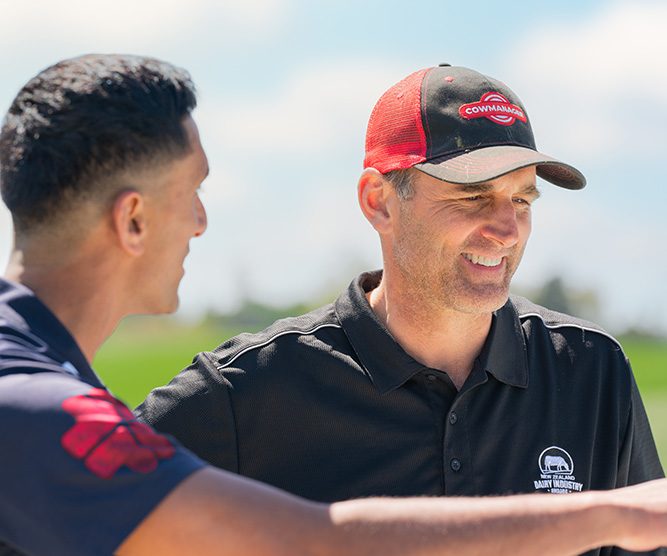
Veterinarian Kyle Kannan (left) and dairy farmer Paul Koopal (right).
The first year Paul and Sarah got CowManager, we were able to look at that, and they were actually behind target for what we call the days to first heat; how fast the cows recover from calving. We were able to find a data point that we would never have seen before and then make changes to impact that data point. We managed to improve it.“
He concludes: “At our reviews we’re able to look at the data, have a look at all the different things coming out of it. It’s basically a set of whole brand-new metrics that we’re able to use now in New Zealand that we probably never been able to. It’s quite a cool frontier that we’re currently in.”
Closing the Loop
From a personal side of things, Paul really enjoys the 24/7 aspect of the CowManager cow tags.
“It allows me to get off farm, because I know someone is looking after my cows, through mating, 24/7”, he says.
He elaborates: “I never used to take any time off during mating period and now I’ll literally just come back from a holiday for four days. It’s brilliant, because I know all those cows are still getting their cycling and are still getting picked up by the system.”
Kyle reckons this is just the beginning – as a vet he’s excited about what CowManager will bring to the future of cow monitoring and farm management.
“This isn’t static technology, it’s bloody on the roll. It’s going to be really cool to see what’s coming in the next couple of years. The Milk Sensor is another thing CowManager are rolling in real soon and that’s basically going to close the loop. All the repro stuff that we’re doing is fantastic, but at the end of the day, milk is the product that we want.”
Listen to Paul and Kyle’s full interview on the REX podcast
A smooth dry off prevents health issues after calving. Extra stress for cows in the dry period could be detrimental to her health and that of her calf. The negative effects could become a factor for multiple generations. The transition period is a make-or-break moment. A troubled stressful and unhealthy transition period can have serious consequences for the health of both the cow and calf after calving. Nearly 80% of diseases occur during the transition period of dairy cows.
But how can you predict these risks in the transition period of these dairy cows?
Identify At Risk Cows Using Data
Identifying a cow that is at risk without the use of technology is a very time-consuming task. On large dairies the number of fresh cows you need to monitor can easily reach 150. Early identification of cows at risk can save you a lot of time, trouble, and money. Data recognises symptoms you would never be able to identify on your own. On top of that, health problems with fresh cows are usually results of issues that have gone on for much longer. In case of changes in behaviour, you search for a possible explanation. In addition to nutrition, there are other reasons why cows become sick after calving. Cows that eat less before calving and become sick after calving already had an inflammatory response before calving.
For example, cows that eat less before calving and become sick afterward already had an inflammatory response before calving. According to Peter Hut, Product Manager at CowManager and veterinarian, there are three reasons for this: inflammation (like mastitis), pain (like lameness), and stress, especially chronic stress from heat or ranking systems, that cows cannot recover from at night.
Pinpoint ‘At Risk’ Cows Before Calving – Transition Alerts
All these uncertainties can be identified with CowManager’s Transition Monitor. Transition alerts can pinpoint ‘at risk’ dairy cows, indicating that this cow could be at risk for health issues after calving. These transition alerts mean the cow is underperforming in the dry period. “Cows are reported showing abnormalities in their behaviour and feed intake from 50 days before the calving date,“ Peter explains. “More than 85% of these cows become sick within 30 days after calving. You want to have these cows insight, so you can apply interventions to prevent illness.”
Proper Preparation with Preventive Interventions
The ‘at risk’ alert doesn’t indicate that an animal is sick, it just notifies you that this specific cow is spending less time eating and ruminating compared to normal behaviour and the herd average. This puts her at risk for postpartum health issues. You may think you need to act immediately, transition alerts are not emergency alerts but rather early-warning indicators that a cow requires closer monitoring. This gives you a clear overview of cows that may become ill after calving, allowing you to address problems before they escalate.
All Eyes On The Recovery
From the moment a cow gets her first transition alert, she remains at risk for diseases until after calving. For cows treated at the transition alert, you can review their recovery easily. No more monitoring based on guesswork. Thanks to the precise data from the Transition Monitor, you know exactly which dairy cows need extra attention during the critical transition period. This benefits your herd and improves efficiency in your operation, saving you valuable time and effort.
Herd Risks During the Transition Period
Monitoring herd risk in the transition period is crucial for effective dairy management. A cow’s immunity is at its lowest, making her vulnerable to diseases like mastitis, metritis, and ketosis. A herd risk monitoring system helps track individual cow health metrics, allowing you to identify patterns or issues affecting multiple cows. Transition dairy cows often face temperature fluctuations, and temperature monitoring in dairy cows during the transition period can reveal early signs of illness, helping you to act proactively.
Fresh Cow Health Risks and Monitoring
Fresh cow health risks are highest in the first few days after calving, as stress and physiological changes affect the cow’s immune system. Implementing a cow health monitoring system can alert you to these risks earlier, tracking feed intake, temperature, and behaviour in real time. This monitoring can help prevent health complications from affecting milk production or calf development.
Conclusion
By adopting a comprehensive herd risk transition period management strategy with the right technology, you can predict, monitor, and intervene before cows become critically ill. Cow health monitoring systems and early intervention are the key to minimising health risks and maximising efficiency, making a major difference for the long-term success of your dairy operation.
Experience smoother transitions and healthier herds with our advanced Transition Monitor. Read more.
Why CowManager?
Monitor Transition, Reduce Risk
The Transition Monitor identifies cows at risk up to 50 days before calving, ensuring proactive intervention and reducing transition diseases.
Monitor Your Herd’s Health 24/7
Our Health Module provides early disease detection. CowManager cows live longer, produce more milk, are in better shape and therefore perform better.
Improve Herd Performance
Your cow's ears are full of vital information. Monitor their rumination, eating, inactivity, activity, ear temperature, and high active behaviour.
Staying ahead of the herd means understanding that dairy farming technology isn’t just a tool — it’s a team player. With the right cow monitoring technology, running your dairy business becomes a collaborative effort, where you can rely on your partner 24/7. This makes the CowManager system more than just a tool in your toolbox; it’s an indispensable team member in your dairy operation.
Digital Dairy Team
Embracing technology has become a necessity. From tracking milk production to monitoring health metrics and even predicting breeding cycles: Cow monitoring systems provide invaluable insights into the well-being of your cattle. It offers farmers ongoing insights to optimise their dairy operations, improve on-farm efficiency, and ensure the health of their herd.
Paul Quinlan is Business Development Manager at Word Wide Sires Australia and has worked in the Australian dairy industry for decades. He believes technology and teamwork are essential to the future of dairy farming. His system of choice? CowManager ear sensors. In fact, for over 120 Australian dairy farmers, Paul and his coworkers are an important part of their digital dairy teams.
Find Out What’s In It For You and Your Herd
Download the brochure to find out more about how the ear sensor works, what dairy farmers in your area think of us, and who your closest local representative is.
Download BrochureTech as a helping hand
“CowManager is cutting-edge technology. It provides modern-day dairy farmers with a precise cow monitoring system”, Quinlan says. The Fertility Module is an absolute must, according to him. It sends users an alert on their pc and phone whenever a cow is on heat.
“It also picks up non-cycling cows, cystic cows”, he adds. “Any data really that’s required specifically before the mating start date. You don’t have to use the traditional heat detection aids, whether it’s kamars or scratchies. You use the technology to do all the work for you.”
People who don’t consider themselves savvy with technology or software have got nothing to worry about, Quinlan promises. “Anytime anyone is moving towards change, they get a little nervous. But we work with a variety of different farmers, with different levels of technical abilities, that are absolutely loving it.”
Work smarter, not harder
The CowManager system isn’t just about collecting data; it’s about helping dairy farmers to interpret and act upon it. Whether it’s fine-tuning reproduction strategies or addressing potential health issues before they escalate, the system provides the insights you need to make informed choices. Why work even harder when farming could be done smarter?
“In this current climate of people looking at their breeding programme and introducing sexed semen, you can utilise the technology to maximise the value of what you’re spending on genetics. Earlier pregnancies with sexed semen not only provide early and oftentimes healthier heifer calves but also contribute to the overall efficiency, maximising genetic potential and minimising downtime”, Quinlan says.
Here to Help
In Australia, CowManager is distributed and supported by World Wide Sires Australia. No one knows the system better than they do. Want to know more? Don’t hesitate to reach out. They’re excited to discuss cow monitoring with you and answer any questions you may have.
Contact the Team“My favourite part of the job is seeing farmers light up when they learn something new.” For Training Specialist Charlotte Dabell, sharing knowledge and helping farmers adopt ear sensor technology is a highly fulfilling job. The world of cow monitoring is ever developing, and Charlotte thrives on being able to help other farmers while also constantly gaining new insights through cow data herself.
With experience on farms in New Zealand and the UK, and an honours degree in agriculture, Charlotte moved into a role as a farm consultant. She has since worked as a Training Specialist at CowManager NZ for over two years, and lives at Jacob’s River Farm in Southland, where she and her husband Callum peak milk 680 cows.
South Island Success Stories
This Training Specialist doesn’t just talk the talk; she walks the walk. Charlotte helps clients based on her experience as a specialist as well as her own experience as a system user; she’s actually tagged her own herd with CowManager ear sensors. She and Callum installed the cow monitoring system on their own farm and have worked with it every day for the past two years. They use the Fertility Module for heat detection, the Nutrition Module for feed and transition management, as well as the Health Module for catching disease early and tracking recovery.
“My partner is the farm manager. It’s good for me to see CowManager in practice. I find that’s quite good for our clients, as well. Because I have used it, I do use it and I know what it looks like,” she explains. “My role is working with people on how to use the system and looking at the different modules, talking to vets and consultants and farmers and showing them how to use CowManager.”
She uses her experience to help CowManager users in the South Island use the system to its full potential. Charlotte’s passionate about the dairy business and all its continuing innovations, and she knows the system inside out. Her favourite part of the job is seeing farmers light up when they learn something new or start to personally experience and understand the benefits of the system.
“Seeing improvements in six-week in-calf rates, empty rates, people who have had milk fever issues being able to get on top of that before it’s an issue. Hearing the success stories, that’s really cool,” she says.
Perfect Tool for Transition Period
Out of all the different modules CowManager offers, Charlotte’s especially specialised in the Nutrition Module, which happens to be her personal favourite. According to her, one major benefit of the Nutrition Module is the ability to look at data from individual cows and compare that to the rest of the herd. You can also split the cows into separate groups.
Charlotte explains: “Say, you had one group that wintered on beets and one that wintered on grass and bailage. You could compare the different transitions for those.”
She believes the Nutrition Module is an extremely important informational tool during the transition period. In the transition period 75% of all adult cow disease events find their origin. With the Nutrition Module, farmers and their team can identify these ‘at-risk’ cows up to 50 days before calving and avoid herd health surprises after calving.
For instance, if dry cows show decreased eating and rumination behaviour and therefore have a higher risk of becoming ill after calving, users will immediately receive an alert. It helps farmers to intervene early and, more importantly, prevent losses.
“For a cow that had a really tough time over winter, she’ll keep giving you transition alerts. It’s looking after the individuals but also seeing the big picture and being able to make improvements on that,” she says.
Diving Into Cow Data Together
For Charlotte, learning new things through cow data has always been fun. She hopes she’ll be able to infect others with that enthusiasm. Not just farmers, but nutritionists, vets, and other consultants as well. With the MultiView function in the CowManager system, remote consultants and staff can get access to cow data with just one click. This allows teams to come to new insights and analyse data together, all the way back to the date of install.
“Get your vets and consultants on board too because a lot of them are really enjoying learning the system. And just enjoy, have fun!”
In her role as Training Specialist, she comes across many different types of (new) system users. From people who eagerly jump right in, to people who are afraid to accidentally ‘mess up’ anything in the system, therefore not using it to its full potential.
“My advice for a beginner would be: You cannot break CowManager. If you want to find something out, just keep clicking, look at the reports, look at the graphs, look at the cows, have a play with it to understand it. So, get stuck in, enjoy it; click as much as you can.”
Benefits of The Nutrition Module
Monitor Transition, Reduce Risk
The Transition Monitor identifies cows at risk up to 50 days before calving, ensuring proactive intervention and reducing transition diseases.
Improve Feed Management
Take your feed management to the next level and monitor ration changes closely. Gain more control to achieve the goals set for your herd.
Stress Less About Heat Stress
Identify heat stress at a very early stage and prevent increased incidence of diseases. This helps to keep your herd and business healthy.
Find Out What’s In It For You and Your Herd
Download the brochure to find out more about how the ear sensor works, what dairy farmers in your area think of us, and who your closest local representative is.
Download BrochureAfter four generations of farming in The Netherlands, CowManager founder Gerard Griffioen decided farming had to be done easier. He thought to himself: What if you could measure a cow’s health, fertility and even recognise heat stress and transition issues beforehand? Always keep a detailed eye on your herd, even when you aren’t physically present? He changed the dairy business forever by inventing the first ever cow monitoring ear sensors in 2004.
CowManager is built and continuously upgraded on years of knowledge, university research and worldwide on-farm tests.
Griffioen: “Every day we gain experience among the cows in our own company. I regularly walk among the cows and discover what could be improved upon, what information is needed.”
And because of his own farming background, he knows it’s best to not work for farmers, but with them.
“We actively listen to our customers. We have customers (and local representatives) worldwide who actively think along about innovations and test them on-farm.” By now, thousands of farmers across the globe monitor their herds with CowManager’s ear sensors, which results in non-stop valuable cow data and ongoing developments. The key to this success? Ear temperature.
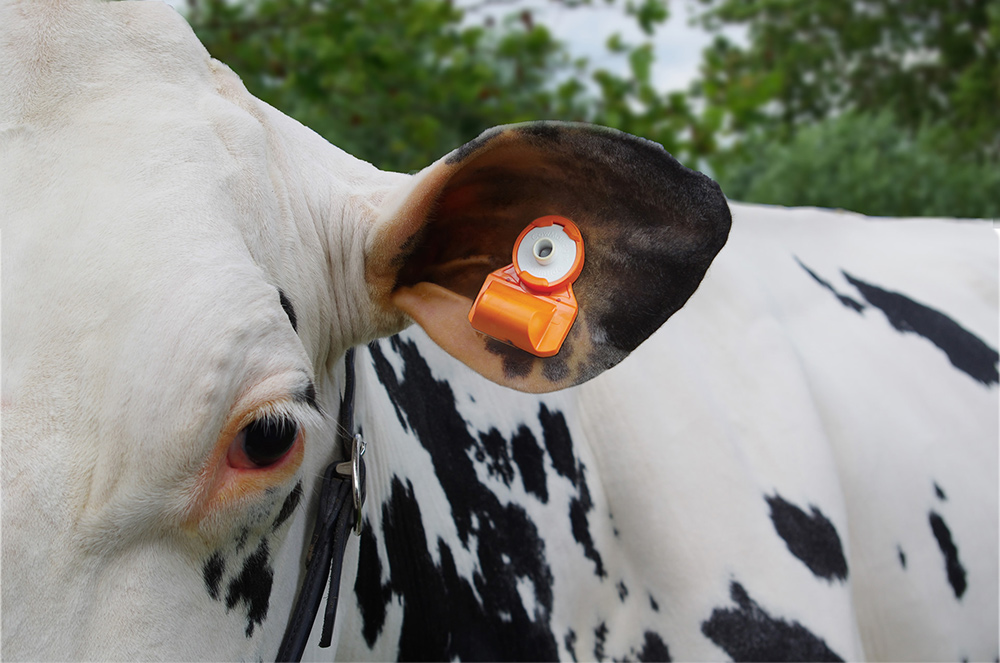
Why Measuring Ear Temperature is Best
In developing a non-invasive system like the ear sensor, Griffioen effectively combined innovative farming technology with so-called old farmer’s wisdom. Back in the day, whenever dairy farmers would doubt if a cow was feeling well, they would first feel her ears to check for a change in temperature.
Cows’ ears are full of vital information which tells us how they’re actually doing. Whenever a cow gets an infection, the blood in the ears moves to vital organs. A crucial sign, which can save you a lot of problems further down the road. CowManager ear sensors monitor cows’ rumination, eating, inactivity, activity, ear temperature and high active behaviour.
The CowManager data graphs show you the ear temperature of the specific cow compared to the average of the total herd. Does a cow have an ear temperature 7°C lower than the herd average, and is there an alert of illness? You’re the first to know. Never miss a heat again, improve your in-calf rates and say goodbye to tail paint and Kamars. On top of that, CowManager cows live longer, produce more milk, are in better shape and perform better.
The Only System with In-Depth Transition Monitoring
CowManager still is the only cow monitoring system out there that is successfully measuring ear temperature combined with other parameters. This combination results in more accurate and earlier alerts. It catches sick cows days before they even show clinical signs of being ill and lets you monitor recovery in detail. It never lets you miss a heat, and makes breeding a breeze, even with sexed semen.
And it makes the transition period – when 75% of all adult cow disease events find their origin – monitorable, recognising underperforming cows up to 50 days before calving, so you can avoid surprises after. And that’s just the tip of the iceberg.
Sharing Data All the Way Back to Install Date
With the MultiView function, which is available on every CowManager system, dairy farmers can easily share important data with veterinarians, staff, herd managers, AI specialists, nutritionists, and researchers. This lets them monitor the herd’s performance as a team, completely changing the way business is done for the better.
CowManager is the only system to give remote access to a cow’s data and history dating all the way back to the install date. It gives you a complete overview of cow data in easy-to-read coloured graphs that allow you to analyse results and progress per cow or group or even season, so you can recognise patterns and opportunities together.
The Future Is in the Ear
Would you like to discuss the benefits of cow monitoring with like-minded people? Get in touch with our local representatives to ask all your questions or to get a personalised quote.
The Total Package
AI Specialist Jim Neuser (USA) shares all of CowManager’s reproduction benefits in this interview. He says: “The producers I work with love CowManager. They tell me that they’re finding cows that need attention sooner and they’re spending less time looking at cows that don’t have any issues, that are good to go.”
According to Neuser, the system is a guide to the complete health and production cycle of each cow.
“It all wraps around the total package of the cow. If they’re not feeling well they’re not going to breed back well and the sooner you can get a cow back feeling better, the more milk you’re going to gain.”
Why CowManager?
24/7 Real-time Data, Never Miss a Heat
Catch heat peaks, possible pregnancies, non-cycling cows and potential abortions. Never miss a thing.
Always Know When to Inseminate
Our alerts and Insemination Window tell you the best time to inseminate a cow. This makes mating and breeding a breeze.
Confidently Use Sexed Semen
View cycling and fertility history in Fertility Insights and see if a cow is suited to be mated to sexed semen.
According to Scott Hecker, AI Specialist and CowManager Specialist, the system’s biggest benefit is the Health Module, and its real-time health alerts.
“Dairymen can address the animals that need it, and not have to wait ’till the next day to see if they responded or not. They can be at lunch behind their computer and look at recovery in real-time.”
Why CowManager?
Catch Diseases Early, Reduce Sick Cows
Get alerted immediately when a cow isn't ruminating or eating, and intervene proactively. Pick up on diseases like mastitis and ketosis at an early stage.
Improve Health & Production
Optimise your farm management by finding cows on heat and catching sick cows earlier, improving your herd’s health and production.
Monitor Your Herd’s Health 24/7
Our Health Module provides early disease detection. CowManager cows live longer, produce more milk, are in better shape and therefore perform better.
“The transition period is a make or break moment”, according to Jeroen Pasman, herd manager at a 1400-cow dairy farm in Russia. He has lived and worked on large dairies in The Netherlands, Germany, and the USA. “Nearly 80 percent of disease incidents happen during the transition period. If the 3 weeks before and the 3 weeks after calving run smoothly for your cows, you’re good.”
Preventive Cow Management with CowManager
With CowManager’s Transition Monitor, underperforming cows are identified early on. The app notifies you when a cow is eating or ruminating less and could therefore be at risk. This way, you can provide early support to minimise the chances of excessive negative energy balance. Pasman: “When a cow shows clinical symptoms of disease, it’s already too late. Thanks to the Transition & Nutrition Monitor, you’re aware of possible risks at an early stage.” In other words, CowManager allows you to help keep your cows healthy, as opposed to helping them recover from an ailment.
Rely On Technology During the Transition Period
According to Pasman, identifying a cow that is at risk without the use of technology is a very time-consuming task: “On large dairies the number of fresh cows you need to monitor can easily reach 150. Thanks to CowManager, the cows you need to monitor on a daily basis are far less. The data recognises symptoms you would never be able to identify on your own. In addition, problems in the fresh cows group are usually side effects of issues that have gone on for much longer. Early identification of cows at risk can save you a lot of time, trouble and money.”
Insights Into Heat Stress and Group Behaviour
The Nutrition Module includes a Heat Stress Monitor and a Group Monitor, that provide you with alerts on eating and rumination behaviour, as well as activity levels. This allows you to assess individual cows as well as compare them to one another. Are they not eating well? Are they experiencing heat stress? You will receive an alert.
During the transition period, you always need to make sure the cows are cooled properly. Pasman: “A dry cow is a heavily pregnant cow. Extra stress could be detrimental to her health, and that of her calf. The negative effects that arise could have an influence for multiple generations. A troubled and unhealthy transition period can have serious consequences for the cow’s offspring.”
Dr. Ray Nebel, Research & Technical Consultant, on heat stress monitoring with CowManager: “Heat stress and its impact occurs when a cow’s ability to dissipate heat is exceeded by heat generated from metabolic heat production and heat gain from environmental sources. Humidity is also a contributing factor to heat stress conditions and the Temperature Humidity Index, commonly referred to as the THI, is the primary method of measuring heat stress.”
Heat stress and its impact occurs when a cow’s ability to dissipate heat is exceeded by heat generated from metabolic heat production and heat gain from environmental sources. Humidity is also a contributing factor to heat stress conditions and the Temperature Humidity Index, commonly referred to as the THI, is the primary method of measuring heat stress.
A wide range of physiologic and behavioural changes result from heat stress: reduced dry matter intake; poor estrus expression; poor oocyte quality; and increased embryo loss. Reductions in milk and reproductive performance during the summertime have been well documented and can be particularly costly to the producer. Lactating dairy cows are especially prone to metabolic heat increases due in part to their high energy diet, high feed intake, and the metabolic activity required for digestion and milk production. These factors lead to excessive core body temperature during heat stress periods and are reflected in 10-20% lower seasonal conception rates across the United States, with greater reduction in sub-tropical and desert regions of the world.
Three ways how dairy cow reproductive performance declines during phases of heat stress
1. The estrus intensity lessens during heat stress, so heat detection becomes more difficult.
2. Fertility is reduced, and finally, the survival of early embryos is compromised. Cows have a homokinetic mechanisms that work to regulate physiology during stress events like heat stress. One of these mechanisms for the dairy cow is the redirection of blood flow from the core to the periphery for cooling. This process can lead to cellular nutrient loss which in turn may hinder fetal development.
3. Another adaptive mechanism is to regulate body temperature by reducing feed intake. It is well known that digestion generates heat, so in theory, reduced feed intake may reduce excessive body heat gain.
What does CowManager measure?
- Rumination: Chewing the cud, standing, or lying (32 -53%)
- Eating: Chewing, licking and/or swallowing feed (10 to 22%)
- Inactive: Doing nothing for 60 seconds, could be lying or standing still (22 to 34%)
- High active: Behaviour related to estrus signs (4 to 12%)
- Active: Non-of-the above, all other categories; walking, drinking water, etc. (7 to 16%)
- Temperature: A real thermometer on the cows’ ear surface, measuring the ear skin temperature
Two temperature sensors on the upper left and right corner on the back of the tag record the ear skin temperature every 15 minutes (using the mean of the two sensors). For accurate temperature measurement the CowManager tag should be approximately in the middle of left ear and in contact with the skin, not above an identification tag.
Figure 1 characterises a herd experiencing heat stress as noted by the elevated black line (temperature) and orange line (activity). February 2021 [in the southern hemisphere] the ear temperature was above 30 degrees Celsius. There is a drop in both rumination (blue line) and eating (green line) times during the period of heat stress. This drop in dry matter intake will result in a cascade of negative events that occur during periods of heat stress.
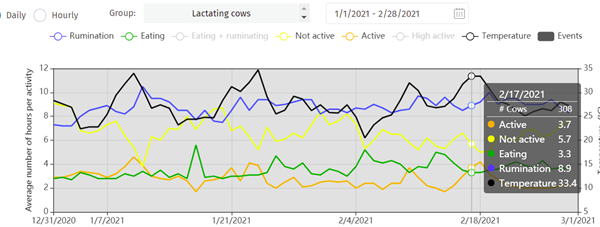
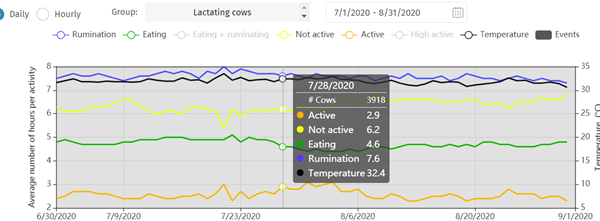
Figure 2 characterises a herd not experiencing heat stress as noted by the elevated black line (temperature) and stable orange line (activity). July of 2020 the ear temperature was above 30 degrees Celsius.
Monitoring heat stress
In dairy cows, heat stress is one of the leading causes of reduced production and reproduction. Heat stress occurs when heat from metabolism and the environment are greater than the cow’s ability to dissipate heat. Cattle rely on panting to cool themselves due to the inability to sweat well. The CowManager system is the only monitoring system that comprehensively and accurately measures rumination, eating, in-active, active, estrus activity, and temperature every fifteen minutes. Using the group overview, one can easily determine if the herd or individual groups or barns are experiencing heat stress. When adding heat abatement measures such as fans, misters, increased feeding times, and/or ration changes, CowManager can monitor their effectiveness in reducing heat stress.